
Precision Fabrication
Optimizing Metal Fabrication: Fiber Laser Cutting vs. CNC Plasma Cutting
An engineering comparison of edge squareness, heat-affected zones, cutting speed and operational efficiency when processing mild steel and stainless steel sheets.
Introduction to Modern Sheet Metal Profiling
In modern industrial manufacturing, sheet metal cutting is the critical first stage of the fabrication workflow. Selecting between High-Power Fiber Laser Cutting and CNC Plasma Profiling determines downstream fit-up precision, welding speed, and total assembly cost.
1. Edge Quality and Squareness
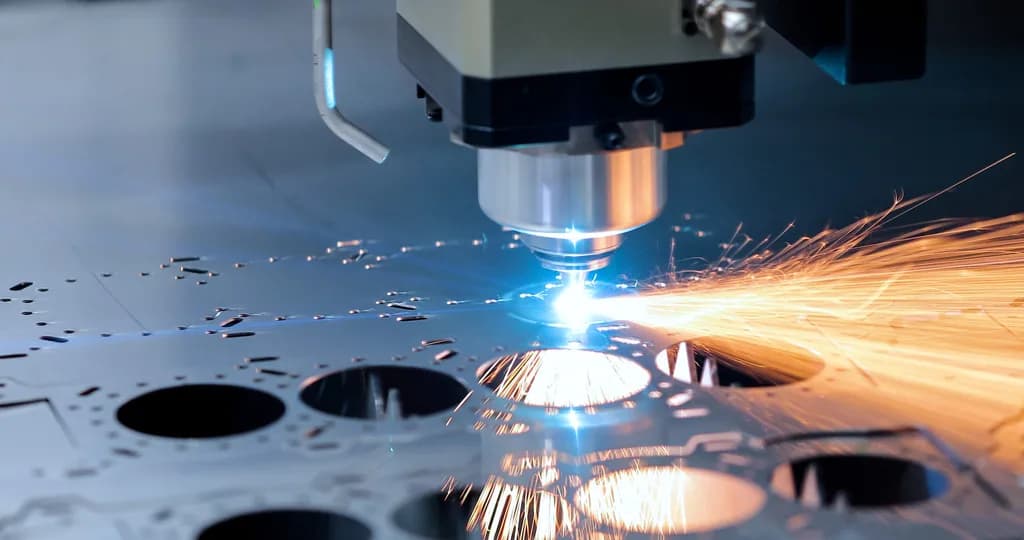
Fiber laser cutting utilizes a focused optical beam with energy densities exceeding 107 W/cm2. This produces a extremely narrow kerf width (typically 0.15mm to 0.3mm) with near-zero angular divergence across plate thicknesses up to 25mm mild steel.
- Fiber Laser: Taper angle under 0.5°, virtually dross-free bottom edges requiring zero secondary grinding.
- CNC Plasma: Bevel angles typically 2° to 5°, with molten slag adhesion on thicker structural plates.
2. Thermal Distortion and Heat-Affected Zones (HAZ)
Because fiber laser travels at higher velocities with localized heat input, the Heat-Affected Zone (HAZ) is reduced by up to 75% compared to plasma. This prevents localized hardening and stress warping in high-tensile structural grades such as IS 2062 E350 or S355JR.
"Reducing the Heat-Affected Zone in sheet profiling is vital for maintaining tight dimensional tolerances during subsequent CNC press brake forming."
Conclusion
For precision machinery enclosures, Special Purpose Machine (SPM) bases, and tight-tolerance mounting brackets, Fiber Laser Cutting provides unmatched speed and surface finish. Sri Ganapathi Industries operates state-of-the-art fiber laser cutting systems in Bengaluru to support high-precision industrial requirements.
Send us your drawing.
Share a drawing, a sample or a description of the part. We will come back with manufacturability feedback and a quotation.